
Pairs exist in nature as a tool for reproduction. Male and female. Two birds of a specific species, the male with different colorings than the female, many times bonded for life. Same with humans. Most of the time the male provides the sperm and the female provides an egg. Or two. Or three or more.
As an a vocational archaeologist I know of other “pairs”. As I’ve wandered around Agua Fria National Monument for the past 16 years or more, pairs of prehistoric dwellings have come to my attention. Some of them larger Pueblo’s (multi-room; sometimes multi-story). Others, smaller field houses with one to five rooms.
There could be many reasons for these prehistoric dwelling pairs. One might be that one group of people build a home and live there for awhile. Then another group comes along and gets permission to build next to them. Or as their family grows some of the younger people split off and build a second building next door.
Another reason could be that there are two polities or clans living side by side. Maybe one is oriented toward summer or daytime activities; the other toward winter or nighttime activities.
It’s also possible that a dwelling just got older and in need of too many repairs. So you build a newer and better building next door and move into it.
Some of the field houses are obviously small shelters built out near farm fields away from the larger pueblos. They are dwellings where you can take shelter from inclement weather; dwellings where you can stay overnight without going back to your main pueblo. If you build a field house at the beginning of a growing season and stay there to work the fields and protect your crop from pests, maybe you abandon it at the end of the growing season. When you come back next year you have the option to repair it for the new season – or simply start anew with a new field house for the new season. Thus creating a “pair” in the archaeological record.
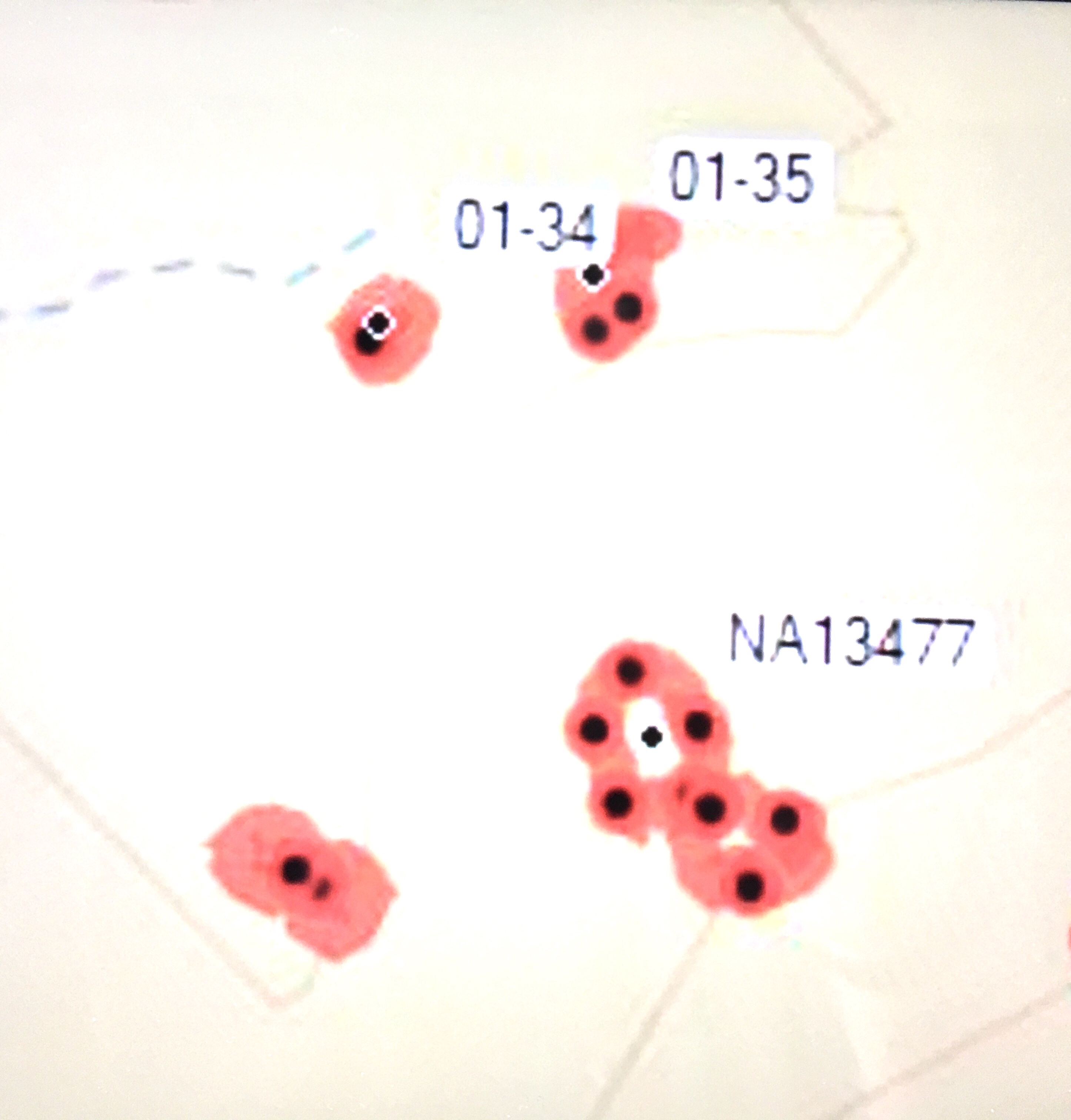
In the image below you can see three larger pairs. The red is actually a greatly magnified view of track lines created around the rock fall of each dwelling by my handheld Garmin GPS as I walked around the remnants of the dwelling. NA13477 and the other numbers are site numbers applied archaeologists as the sites are recorded. For some reason, the two dwellings in the lower left were never formally recorded. NA13477, which in my faulty memory and in the absence of my records as I write this could have about 75-100 rooms, actually has a small area in between the upper and lower structures big enough to walk between them. The unrecorded dwellings have a Jeep trail that goes right between them. Some people might not feel that 01-34 and 01-35 are actually a pair. There may be too much space between them to qualify, both spatially and temporally.
Remember, I’m an avocational archaeologist, not a professional. I don’t have all the training, study and experience of the professionals – or the ethnographic info passed down generation to generation by today’s native Americans. So, I’m presenting reasons for the pairs which are based on snippets of information I’ve gleaned from seminars, readings and word-of-mouth. But, hey! They sound good, right?
 arizonamike
It does sound plausible, and it is very interesting as well!
LikeLiked by 1 person
Thank you!
LikeLiked by 1 person